

Industry:
Industrial Goods
Use case
Real-time dashboards, continuous aggregates, and month-end reporting for 24/7 manufacturing plants
Impact
- Reliable infrastructure, reduced costs, simplified month-end reporting
We used Tiger Data as our data foundation; as the single source of truth.
Chase Witt, Senior Software Engineer
How Titan America Unified Manufacturing Sensor Data with Tiger Cloud on AWS
Titan America unified fragmented data pipelines onto AWS, enabling real-time operational intelligence and simplified reporting across three plants.
Titan America, a heavy building materials producer with cement plants, aggregates operations, and ready-mix concrete facilities across the eastern United States, moved its manufacturing telemetry pipelines from direct CSV dumps to Tiger Cloud on AWS. The outcome: a single source of truth for OT (operational technology) sensor data from 24/7 production facilities, continuous aggregates feeding real-time dashboards and month-end reporting, and infrastructure that works reliably. In this case study, we will walk through how Titan America evaluated the move and what the unified data foundation means as the business scales.
About the Company & Team
Manufacturing facilities produce continuous streams of sensor data: vibration, temperature, pressure, throughput, equipment state. That data lives in plant SCADA systems. While it can indicate whether a production line is running well or heading towards failure, extracting that insight isn't always straightforward. The operational applications that run the business (controlling production lines, managing equipment, coordinating shifts) live at the plant and have been doing their job reliably for decades. Titan's challenge wasn't replacing those systems. Instead, the company wanted to siphon off that continuous sensor data stream to do additional work in the cloud: historical analysis, trend detection, predictive maintenance, and reporting that the plant-based systems weren't designed for. Getting data reliably out of the plant, into a queryable system, and connected to operational applications is not easy. Legacy pipelines rely on CSV exports, scheduled batch dumps, or direct connections that fail when the network hiccups.
Titan America runs three plants (Miami, Tampa, and a recently acquired facility in Pennsylvania) 24 hours a day producing cement clinker, aggregates, and ready-mix concrete. Downtime hits customer deliveries immediately. The Industrial Digitization team needed a data architecture that could ingest, store, and serve millions of sensor readings per day with the reliability and query performance that real-time manufacturing operations require.
The team is led by Matt Markham (Manager of Industrial Digitization), Chase Witt (Senior Software Engineer), and Dante Ricketts (Jr. Data Engineer), working with data scientists and analysts to turn sensor streams into actionable insights.
The Challenge
Titan America's old pipeline was fragile and expensive. Raw OPC (OLE for Process Control) sensor data from plant SCADA systems flowed through a custom Python app, which dumped CSV records directly into their BI tool. The architecture was not cost-effective nor resource-efficient as it burned a lot of resources in their BI tool.
The BI tool was the source of truth. Every analytical query hit their BI tool, creating a bottleneck where there was no efficient way to store historical data, apply transformations, or run time-series queries without slowing it down. Network interruptions caused data loss, and the company couldn't implement data retention policies or tiered storage. Operations like compression, continuous aggregation, or state-machine logic simply weren't part of the BI layer's design.
The primary motivation to move was unreliability and maintenance burden. The old system consumed significant engineering resources just keeping it running and diagnosing issues. Titan needed tight integration between data collection and storage to reduce constant firefighting.As plants were added, data volume grew but the architecture stayed stuck on CSV-to-BI. The company needed a proper data foundation (their "bronze layer") to serve as the single source of truth for all OT data.
Why Tiger Cloud: An Architecture-First Decision
Titan America evaluated databases with one requirement: a single source of truth for time-series data that could handle millions of readings per day, serve historical queries efficiently without BI slowdown, support continuous aggregation for real-time dashboards, and stay operationally simple. Self-hosting wasn’t the right choice at that time, because Titan America was a lean team carrying significant technical debt, and they needed to find a way out of the bind they were in. The old system was fragile and consumed enormous effort just to maintain, so stability was the primary driver. Running a time-series database in-house means dedicated DevOps, capacity planning, backup and recovery. It also requires taking on overhead that distracts from the core problem: reliable ingestion and fast queries.
Tiger Cloud on AWS offered what they needed in two ways. First, the managed service meant the team could focus engineering effort on building reliable data collection at the source and on the data model itself, rather than on infrastructure and operations. Second, Tiger Cloud provided capabilities the open-source TimescaleDB extension didn't: automatic long-term storage conversion to Parquet files, SQL functions for state aggregation and state timelines, and a range of production-grade features that would have required custom engineering to build.
As Witt explained, “We started with TimescaleDB when it came to replacing what was originally collecting our plant data. We could store this amount of data and query it efficiently. So we used Tiger [Cloud] as our data foundation - the single source of truth.” Tiger Cloud gave them exactly what they needed: performant, reliable infrastructure for operational and analytics workloads on time-series data, without the burden of self-hosting.
The Tiger Cloud Stack
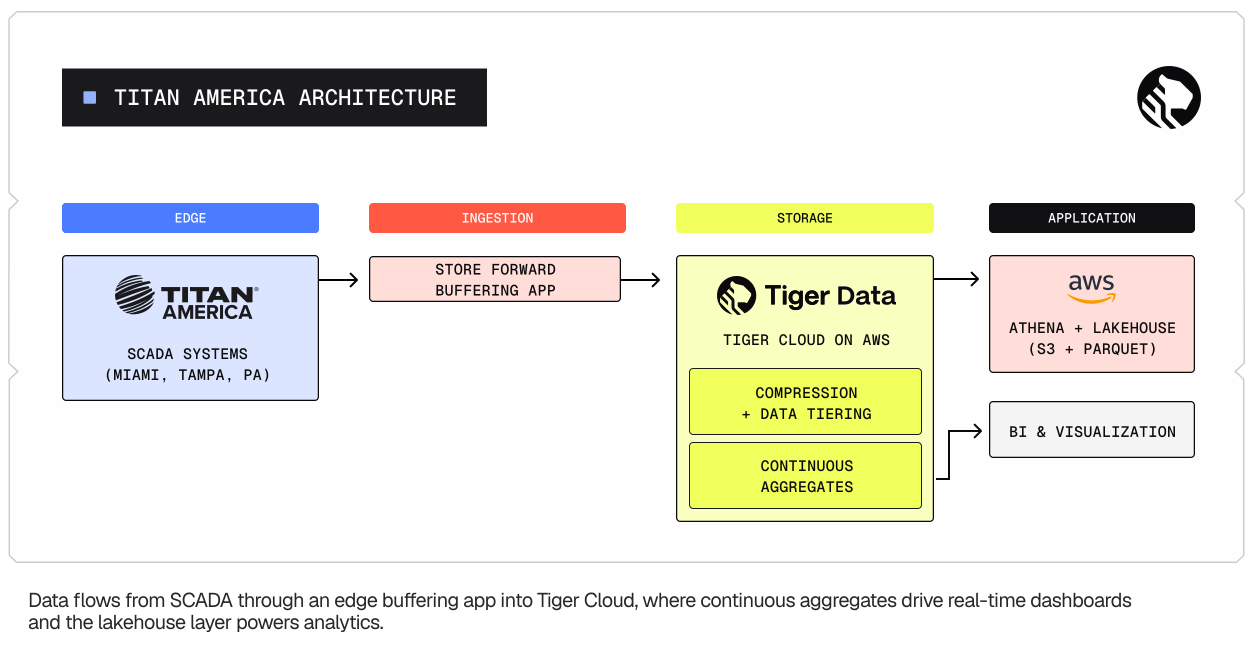
The data flows from plant to cloud in layers. SCADA systems emit OPC readings continuously: thousands of data points per minute from kiln temperature, clinker moisture, concrete slump, equipment vibration sensors, and more. Rather than write directly to the cloud, Titan built a custom buffering app between SCADA and Tiger Cloud. This app captures readings, stores them locally, and implements store-and-forward logic: if network connectivity drops, the app queues messages and retransmits when connectivity returns. In a 24/7 manufacturing environment, network blips are inevitable.
Data flows from the buffering app into Tiger Cloud on AWS through a reliable ingestion pipeline. The cloud instance has five Tiger Cloud services running TimescaleDB, using roughly 7 CPU cores and 913 GB of active storage. The primary hypertable is node_value; every OPC reading lands here with a timestamp, node ID, and value.
Titan uses Tiger Data compression extensively. The node_value table is configured with compress_segmentby='node_id' and compress_orderby='server_timestamp DESC'. This means historical data compresses automatically by sensor ID; recent data stays uncompressed for fast queries and older data shrinks by orders of magnitude while remaining queryable. Data tiering is enabled too: hot data stays in fast storage for 2 weeks, then migrates to lower-cost tiers. The result: about 19 TB of tiered data on Amazon S3 across the instance.
Continuous aggregates sit on top of the raw hypertable and offer pre-computed, materialized views that update as new data arrives; examples include aggregate metrics per sensor and plant-level summaries. These power real-time dashboards in Grafana and simplify consumption in their BI tool. The continuous aggregate approach lets Titan capture complex business logic (state machines, timeline functions, process metrics) directly in the database using TimescaleDB functions, rather than in application code.
Downstream, data flows from Tiger Cloud into a silver layer (Amazon Athena with S3 parquet storage) and into their BI tool for business intelligence. A Python app reads from TimescaleDB, builds analytical datasets, and writes them to the lake. This separation of concerns–raw bronze layer (TimescaleDB), silver refined layer (Amazon Athena), gold curated layer (their BI tool)–lets the company scale analytics independently from the operational time-series database.
Results: What We've Seen
Transforming fragile pipelines into reliable infrastructure (while reducing costs): The first win was reliability. Moving from CSV dumps to a proper time-series foundation cut operational complexity. According to Markham, “We shifted our raw time series ingestion from Python dumping CSVs directly into their BI tool into [Tiger Cloud]. That's been one of the least problematic and most robust things we've ever done.” For a 24/7 manufacturing operation, that's a significant statement. Reliable infrastructure means fewer incidents, less manual work, and more engineering time spent on features instead of firefighting. Throughout their usage on Tiger Data, the team backported nearly 1 TB of legacy OPC data into Tiger Cloud and enabled compression immediately. That historical dataset shrank significantly, letting the company retain years of sensor data without proportional storage cost increases.
“We used Tiger Data as our data foundation; as the single source of truth.”–Witt, Senior Software Engineer, Titan AmericaContinuous aggregates simplifying month-end operations: Titan is implementing continuous aggregates to feed SAP and month-end reporting. Before Tiger Cloud, generating monthly reports meant ad-hoc queries, manual aggregations, and reconciliation work. As continuous aggregates mature, they will run automatically, computing summaries (total cement produced, average kiln temperature, equipment utilization) that feed directly into ERP and reporting systems. Early testing has shown zero data-integrity issues over two months. This is still early work, and the team is working through the stack to address the most painful parts first. But reliable month-end reporting is foundational for a manufacturing business on tight margins with customer SLAs, and this is the direction Titan is headed.
Foundation for operational intelligence: With a unified time-series foundation in place, Titan is exploring new use cases that weren't feasible before. The team is testing AI agents that ingest shift event logs and generate summaries, identifying anomalies and actionable issues automatically. And they're investigating Tiger Lake for long-term retention and bidirectional lake connectivity, letting cold data flow back into real-time queries when needed.
Growth through consolidation: The consolidation of manufacturing facilities shows land-and-expand in action. Titan started with two plants and recently added a third. Rather than duplicate infrastructure or struggle to integrate new plants into a legacy pipeline, the team added SCADA sources to the buffering app and expanded Tiger Cloud capacity. The single source of truth meant integrating new facilities was straightforward: no redesign, no complex migrations. As Titan America continues to grow, the team plans to replicate this architecture across new facilities, confident the approach will continue to work well.
Looking Ahead
Titan manages 19 TB of time-series data on Tiger Cloud using a tiered retention strategy: one year raw, five years in continuous aggregates, older data archived in S3. Although the strategy is in use, it continues to be refined and optimized. On the roadmap: upgrading Postgres instances for newer TimescaleDB features and implementing direct Parquet export to S3. This cost efficiency means the team focuses on capabilities that matter: AI agents for predictive maintenance, semantic search, real-time anomaly detection. As Titan expands its manufacturing footprint, the data model remains constant and performance scales automatically, freeing engineers to solve manufacturing problems instead of managing databases.
// you may also be interested in

Industrial Goods
Videojet Technologies is a world-leader in the product identification market, providing in-line printing, coding, and marking products
Industrial Goods
Bapi Sensors is a leading sensor manufacturer for HVAC/R.