

webinar
Sizing a Battery Storage Telemetry Database Before the Fleet Scales
Date
Tuesday, October 06, 2026
Time
12:00 - 1:00 ET
Location
Virtual (link sent upon registration)
Abstract
Every energy telemetry project starts the same way. One site, a few thousand channels, a database that answers in milliseconds. Then the pilot becomes a portfolio, and the architecture that worked for one battery site or one charging depot stops working entirely.
The reason is usually not a bad query. It is that nobody drew the boundary. Every database has a range of conditions inside which it performs to spec, and outside which it fails. That boundary is the performance envelope, and it is defined by three things: how much storage you can afford, how fast you can ingest, and how slow your queries are allowed to get.
Battery storage makes the math unforgiving. Cell-level voltage, temperature, and state of charge across a utility-scale site produces tens of thousands of channels per site, and warranty and degradation analysis means you cannot downsample the history away. The data you throw out at month six is the data the claim depends on at year four.
This session walks through how to calculate that envelope for a real fleet-monitoring workload before you commit to an architecture. We do the math on a 25,000 channel deployment at 1 Hz, look at what five years of full-resolution retention actually costs on cloud SSD, and show where the ingest wall sits. Then we look at what happens to that envelope when you add TimescaleDB to Postgres rather than replacing it.
What you'll learn
How to calculate total data volume and five-year storage cost for a given channel count, sample rate, and retention requirement
Why compliance and warranty retention windows break the assumptions behind most downsampling strategies
Why the maximum ingest rate degrades as a Postgres table grows, and how to spot the backlog before it becomes unrecoverable
Where vertical scaling, sharding, and a purpose-built time-series database each stop being the right answer
Can’t make it live? Register anyway and we’ll send you the recording.
Register free
You might also be interested in
workshop
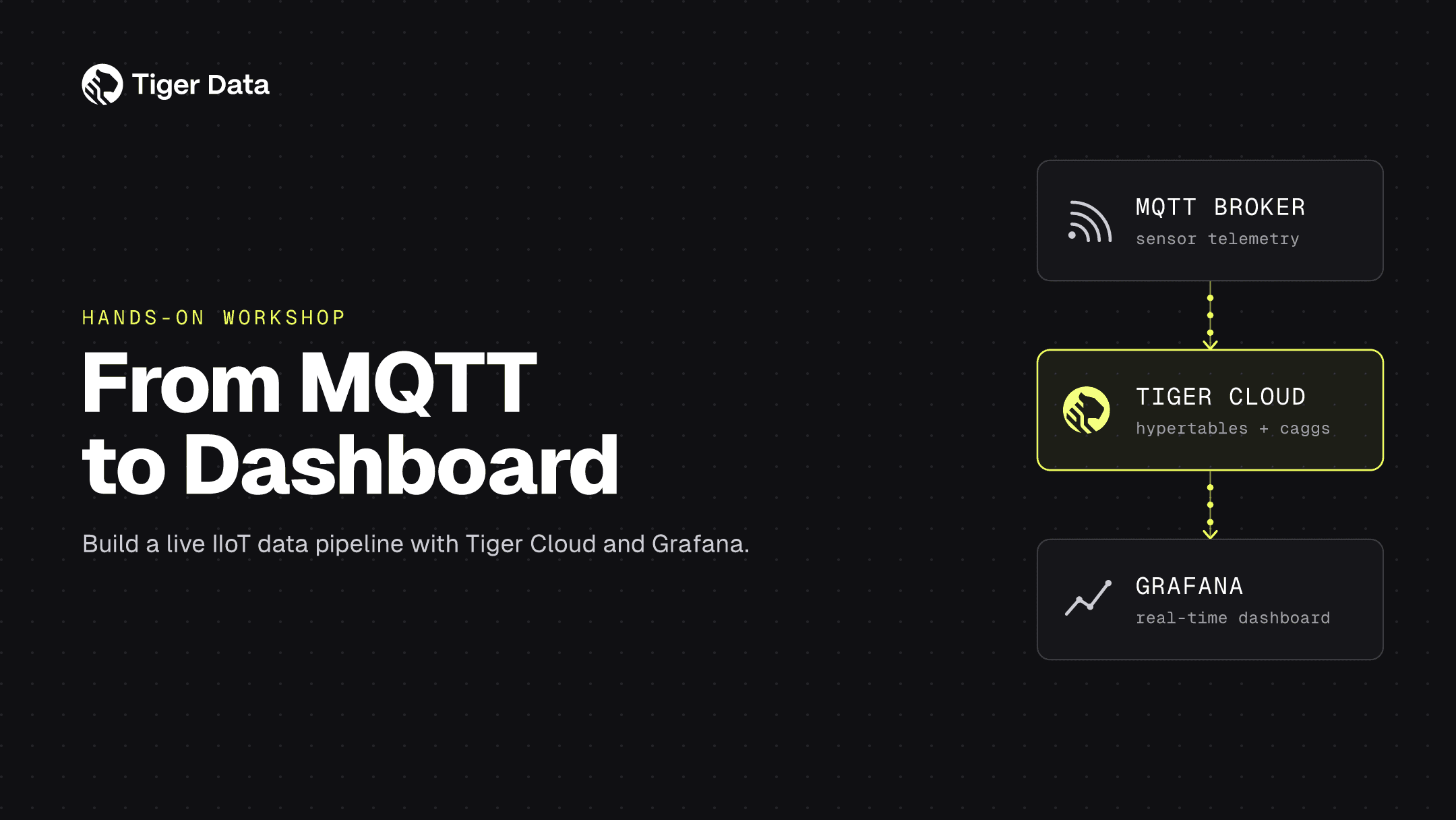
From MQTT to Dashboard Real-Time IIoT Pipelines with Tiger Cloud
In this hands-on workshop, you'll build a working pipeline from MQTT to Tiger Cloud to Grafana. You'll subscribe to an MQTT broker, ingest live sensor readings into Tiger Cloud, and wire it all to a real-time Grafana dashboard.
Sep 09, 2026
Virtual (link sent upon registration)
NYC
Livestream
Aggregate 2027
Tiger Data's free one-day event in NYC for the people building on time-series and Postgres — March 10, 2027.
Mar 10, 2027
New York
workshop
Fork, Break, Fix, Delete: Hands-On with Tiger MCP
In this hands-on workshop, you'll wire Tiger MCP into the coding agent you already use and give it a database it's allowed to break.
Oct 21, 2026
Virtual (link sent upon registration)