

Postgres wins for time-series at scale

Keep your SQL.
Keep your history.
Skip the rewrite.

Tiger Data, from the creators of TimescaleDB, brings full Postgres to high-volume time-series. InfluxDB moved to a new engine and dropped Flux support between v2 and v3. TimescaleDB is the same PostgreSQL you already know, at scale.

Trusted by teams running time-series at scale, from IoT to AI

Customer proof

Built for time-series at scale. Trusted by real teams, including teams that moved off InfluxDB.

We also tried InfluxDB before settling on TimescaleDB. We ran into ingestion issues, and we needed SQL. When you are a three-person team building an asset-centric microservice platform, you cannot afford a database that requires a proprietary query language and limits how you join and query data across domains.

Victor GrabowCTO
Learn more
Compared to InfluxDB, our teams found that implementing TimescaleDB had a shorter learning curve and delivered better ingest and query performance with the same engineering effort. Just as importantly, using a unified PostgreSQL/TimescaleDB architecture reduced maintenance overhead and gave us consistent deployment options, from cloud to on-prem, without changing the core data layer.

Enrique RiesgoChief Software Engineer
Learn more

The main takeaway for me was: in our use case, where we're going to have thousands of devices in the field requiring real-time dashboard analytics, TimescaleDB is the best choice. InfluxDB couldn't deliver on this use case for high ingestion across thousands of devices at scale.

Farbod MoghaddamCTO & Co-founder
Learn more

TimescaleDB delivered with 100% PostgreSQL design, more than 7x storage space savings thanks to compression, and 10x–40x faster queries.

Rafal KulagaStaff Software Engineer
Learn more

Why Not
InfluxDB

InfluxDB is quick to stand up for a metrics pipeline. At scale, teams hit architectural limits that turn into rewrites, workarounds, and a second system to run.

Query language churn → rewrites each major version

InfluxDB moved from InfluxQL to Flux to SQL across versions. Flux is not supported in v3, so v2 queries, tasks, and dashboards built on it have to be rewritten.

Not a relational database → data lives in two systems

InfluxDB 3 added SQL through DataFusion, but it is a time-series and event store, not a general-purpose relational database. Joining time-series with your relational data means crossing a system boundary.

No native continuous aggregates → more moving parts

InfluxDB 3 has no built-in continuous aggregates or materialized views. The documented pattern is a trigger plus a downsampler plugin, which adds complexity and extra storage.

Free tier limits → capped before you scale

InfluxDB 3 Core is single-node with retention and database limits, including a 72-hour query window on recent data. Lifting them means moving to Enterprise or Cloud.

A separate stack → operational overhead

You run and scale a dedicated time-series engine alongside your system-of-record, instead of keeping time-series and relational data in one Postgres.

Where InfluxDB is genuinely strong

High-velocity ingest, unlimited cardinality in v3, a permissive open-source Core license (MIT / Apache 2), and the Telegraf ecosystem. We say so plainly, and weigh it in the full comparison.

What starts as a quick metrics store turns into query rewrites, aggregate workarounds, and a second database to operate.

Why developers choose Tiger Data

Tiger Data is Postgres, purpose-built for time-series and analytics at scale.

Built by the team behind TimescaleDB. Everything Postgres, plus time-series power, without sharding or trade-offs.

TigerData logo

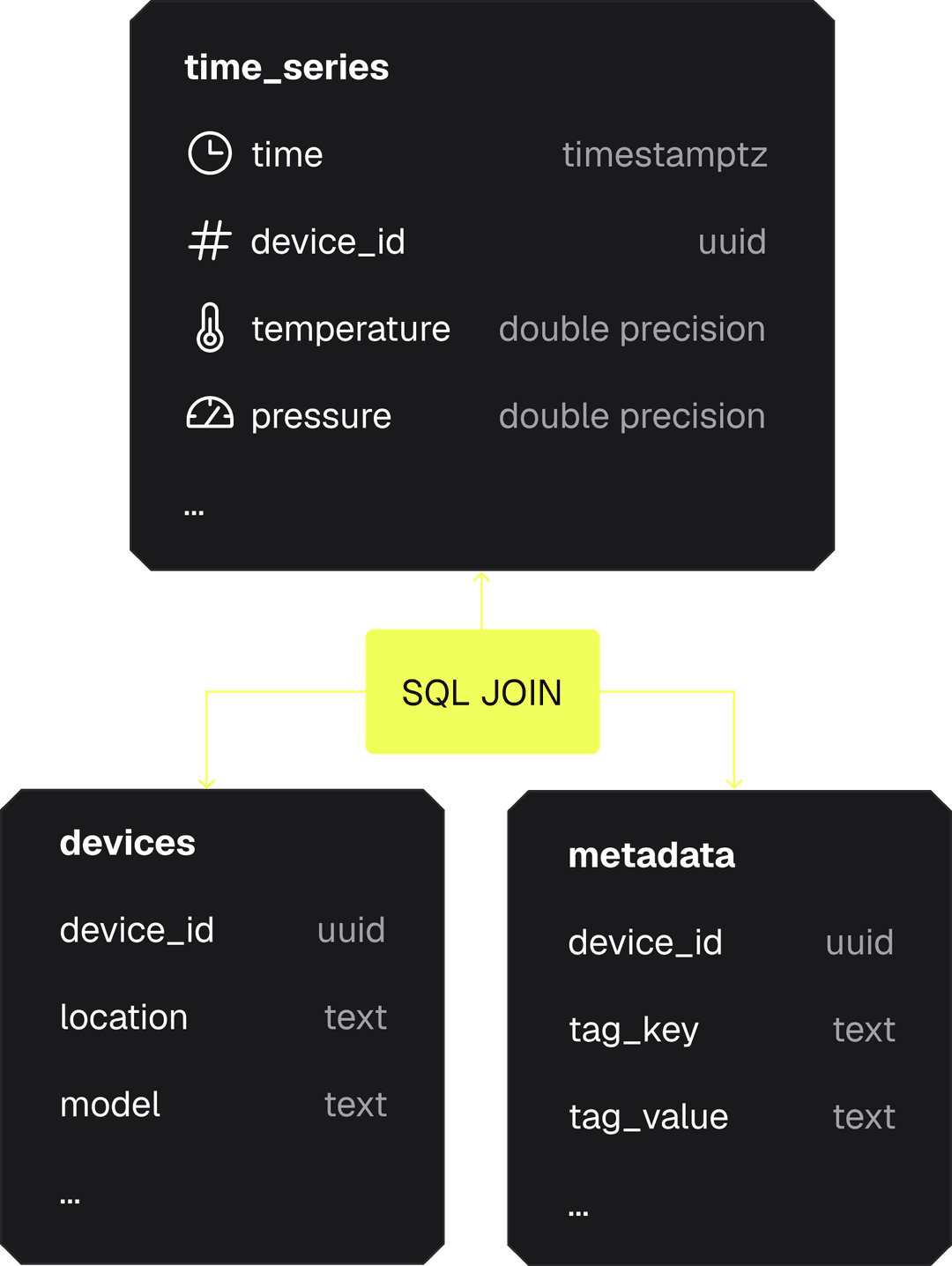
PostgreSQL + time-series extensions

tigerdata-schema
  • Full relational model with joins, foreign keys, and constraints

  • ACID transactions for reliable writes and reads

  • SQL for operational queries and complex analytics

  • Time-series extensions: continuous aggregates, compression, downsampling, gapfill

  • Everything in one database, one set of tools

InfluxDB logo

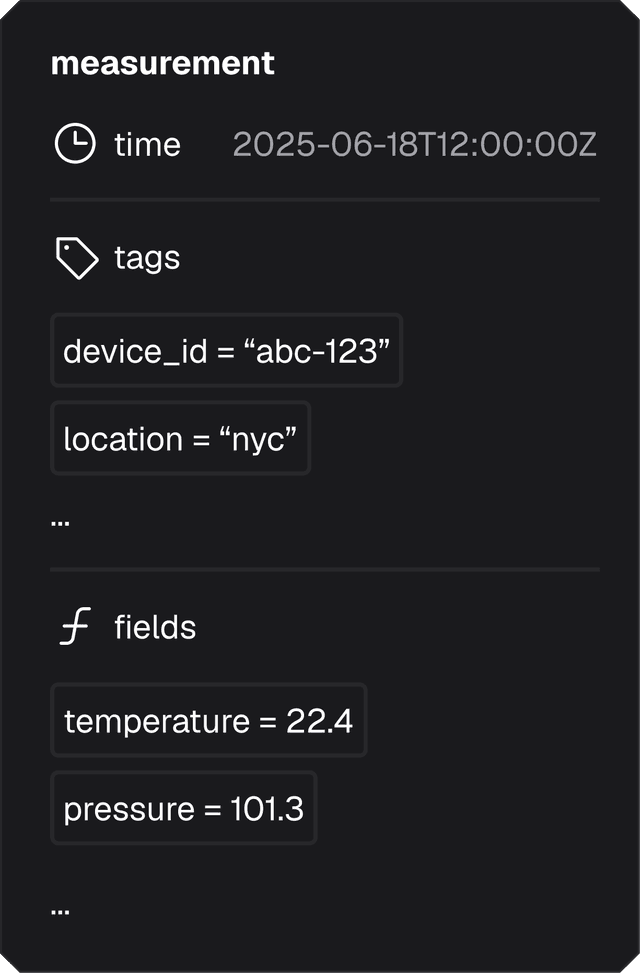
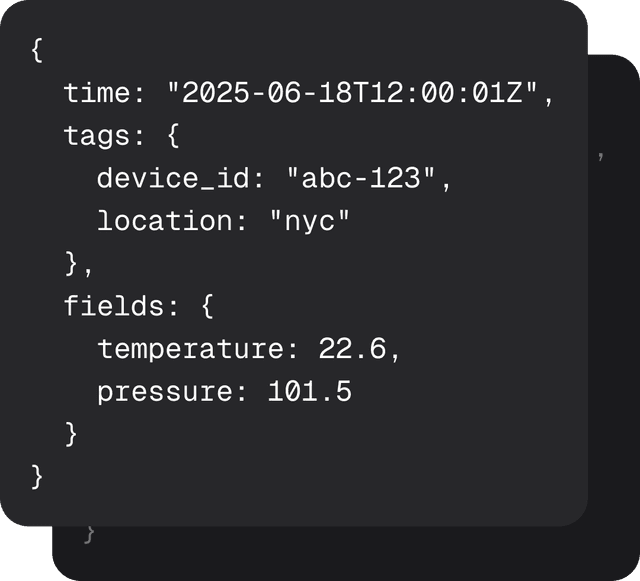
Document & nonSQL data model

influxdb-scheme-1influxdb-scheme-2
  • Document model with tags and fields

  • No native joins or referential integrity

  • Limited query language (Flux)

  • Analytics require workarounds and external tooling

  • Operational and analytical data often live in separate systems

InfluxDB vs Tiger Data for time-series

Tiger Data makes Postgres powerful for time-series with fast, affordable, and familiar database features.

Query language

Full PostgreSQL SQL, the same language across every version

Works with existing drivers, ORMs, and BI tools

Data relationships

New capabilities extend the same Postgres engine

No boundary where your query language stops being supported

Analytics & rollups

Native SQL joins, foreign keys, and constraints

Time-series and relational data in one database

Scale & storage limits

Built-in continuous aggregates with auto-refresh

Native downsampling

AI & vector

Native vector search via pgvector and pgvectorscale

Hybrid search in one query: BM25 keyword search (pg_textsearch) with vector search (pgvectorscale)

Embeddings, time-series, and relational context in one query

This table covers where Tiger Data leads. InfluxDB has genuine strengths of its own, noted above. Choose based on your workload.

Get started with Tiger Cloud

A mature, reliable, worry-free Postgres cloud for
time-series data. Built for developers. Battle-tested at scale.

Compression, joins, and materialized views out of the box

Full SQL compatibility

No sharding required

Start a free trialBook a technical consult