TigerData logo
TigerData logo
  • Product

    Product

    Tiger Cloud

    Robust elastic cloud platform for startups and enterprises

    TimescaleDB Enterprise

    Self-managed TimescaleDB for on-prem, edge and private cloud

    Open source

    TimescaleDB

    Time-series, real-time analytics and events on Postgres

    Search

    Vector and keyword search on Postgres

  • Industry

    Data Centers

    Energy & Utilities

    Oilfield Services

    Smart Manufacturing

    Crypto

  • Docs
  • Pricing
  • Developer Hub

    Changelog

    Benchmarks

    Blog

    Community

    Customer Stories

    Events

    Support

    Integrations

    Launch Hub

  • Company

    About

    TigerData logo

    Timescale

    Partners

    Security

    Careers

View on GitHub (opens in a new tab)

Contact usStart a free trial
Tiger Data

Products

  • TimescaleDB
  • Tiger Cloud
  • TimescaleDB Enterprise
  • Postgres Search Stack

Industry

  • Data Centers
  • Energy & Utilities
  • Oilfield Services
  • Smart Manufacturing
  • Crypto

Support

  • Cloud Status
  • Support
  • Security
  • Terms of Service
  • Code Of Conduct

Learn

  • Documentation
  • Blog
  • Tutorials
  • Changelog
  • Success Stories

Company

  • About
  • Contact Us
  • Careers
  • Newsroom
  • Brand
  • Events
Privacy preferencesLegalPrivacySitemap
Strategic Partner with Inductive Automation — Ignition

2026 (c) Timescale, Inc., d/b/a Tiger Data.
All rights reserved.

Tiger Data

2026 (c) Timescale, Inc., d/b/a Tiger Data.
All rights reserved.

Privacy preferencesLegalPrivacySitemap

Expanding Pgai Vectorizer: SQLAlchemy and LiteLLM Make Vector Search Simple

M

Meshach Cisero

Avthar Sewrathan

Avthar Sewrathan

February 17th, 2025

3 min

Share

M

Meshach Cisero

Avthar Sewrathan

Avthar Sewrathan

February 17th, 2025

3 min

Share

Copy as HTML

Open in ChatGPT

Open in Claude

Open in v0

AI

Table of contents

  1. 01 SQLAlchemy: Store and Query Vectors Like Any Other Column
  2. 02 LiteLLM: Swap Embedding Providers With a Single SQL Command
  3. 03 Get Started in Minutes
  4. 04 What’s Next?
Start building
Expanding Pgai Vectorizer: SQLAlchemy and LiteLLM Make Vector Search Simple

We built pgai Vectorizer to simplify embedding management for AI applications—without needing a separate database or complex infrastructure. Since launch, developers have created over 3,000 vectorizers on Timescale Cloud, with many more self-hosted. 

image
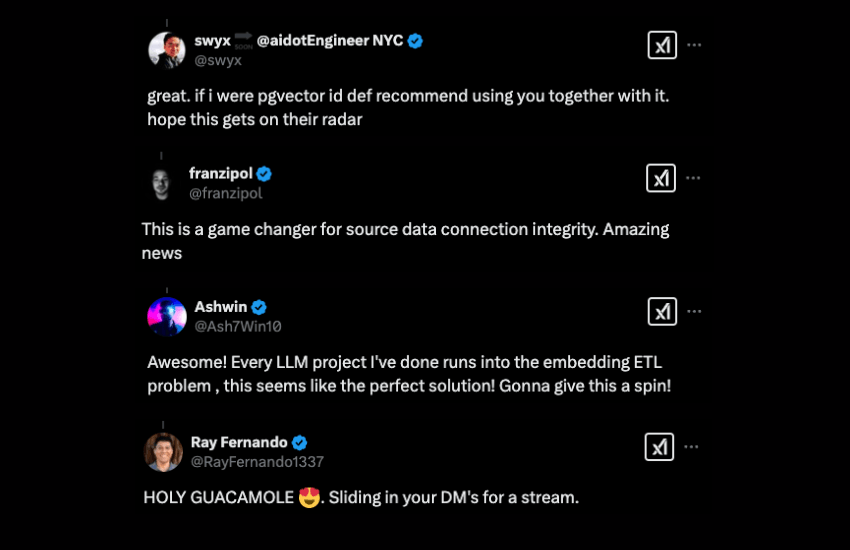
Some of the feedback we received on X following the pgai Vectorizer launch. Sources: Swyx, Franzipol, Ashwin, and Ray Fernando

But developers wanted pgai Vectorizer to work with familiar application-building tools and support more embedding providers. Today, we're making that happen with two key updates:

  • SQLAlchemy support: The most widely used Python ORM, SQLAlchemy lets you work with databases using Python instead of raw SQL. Now, pgai Vectorizer integrates directly, so you can store and query vector embeddings like any other column using SQLAlchemy queries.
  • More embedding models via LiteLLM: LiteLLM provides a simple API for multiple embedding providers. Now, pgai Vectorizer works with OpenAI, Cohere, Hugging Face, Mistral, Azure OpenAI, AWS Bedrock, and Google Vertex—all from a single SQL command.

These updates make working with embeddings in Python simpler and more flexible—no extra complexity, just tools that fit into your existing stack.

(More on why we built pgai Vectorizer: Vector Databases Are the Wrong Abstraction.)

SQLAlchemy: Store and Query Vectors Like Any Other Column

SQLAlchemy, a Python ORM that abstracts SQL queries, now integrates with pgai Vectorizer, allowing you to store and query embeddings just like any other database column—without writing raw SQL.

  • Embed and retrieve vectors like any other column: Define embeddings as structured fields inside your models.
  • Run vector similarity queries inside ORM expressions: No need for raw SQL or external vector stores.
  • Use Alembic migrations: Keep schema changes version-controlled.

This makes it easier to store, retrieve, and update embeddings inside Postgres while keeping everything ORM-native.

op.create_vectorizer(     source="blog",     embedding=OpenAIConfig(         model='text-embedding-3-small',         dimensions=768     ),     chunking=CharacterTextSplitterConfig(         chunk_column='content',     ),     formatting=PythonTemplateConfig(template='$title - $chunk') )

LiteLLM: Swap Embedding Providers With a Single SQL Command

Choosing the right embedding model affects cost, performance, and accuracy—but switching providers shouldn’t require rewriting queries. LiteLLM removes that friction by enabling seamless provider swaps with a single SQL command—no query rewrites, no manual reprocessing.

  • Switch providers instantly: Test OpenAI, Cohere, Hugging Face, Mistral, Azure OpenAI, AWS Bedrock, and Google Vertex with minimal effort.
  • No query rewrites: Applications continue working regardless of the embedding provider.
  • Keep old embeddings while switching: Ensures smooth transitions without downtime.
SELECT ai.create_vectorizer(     'my_table'::regclass,     embedding => ai.embedding_litellm(         'cohere/embed-english-v3.0',         1024,         api_key_name => 'COHERE_API_KEY'     ),     chunking => ai.chunking_recursive_character_text_splitter('contents') );

LiteLLM is available for self-hosted users now and will be coming to Timescale Cloud soon.

Get Started in Minutes

Pgai Vectorizer’s SQLAlchemy and LiteLLM integrations are available now, making it easier than ever to store, query, and experiment with vector embeddings inside Postgres.

Try it today

  • Install pgai Vectorizer from GitHub
  • Define a vector column using SQLAlchemy
  • Test different embedding providers with LiteLLM

For self-hosted deployments, an external worker is required to process embeddings. In Timescale Cloud, this is automated to handle API calls and scale workloads dynamically.

What’s Next?

Pgai Vectorizer is just the start. We’re building a broader AI-native database experience where Postgres supports smarter indexing, advanced AI search, and deeper integrations with AI tools. Expect more enhancements that make Postgres the best place to build AI applications.

Join our Discord community to share feedback and see what others are building.

// Related posts

RAG Complexity Is a Bet Against the Model

AI

RAG

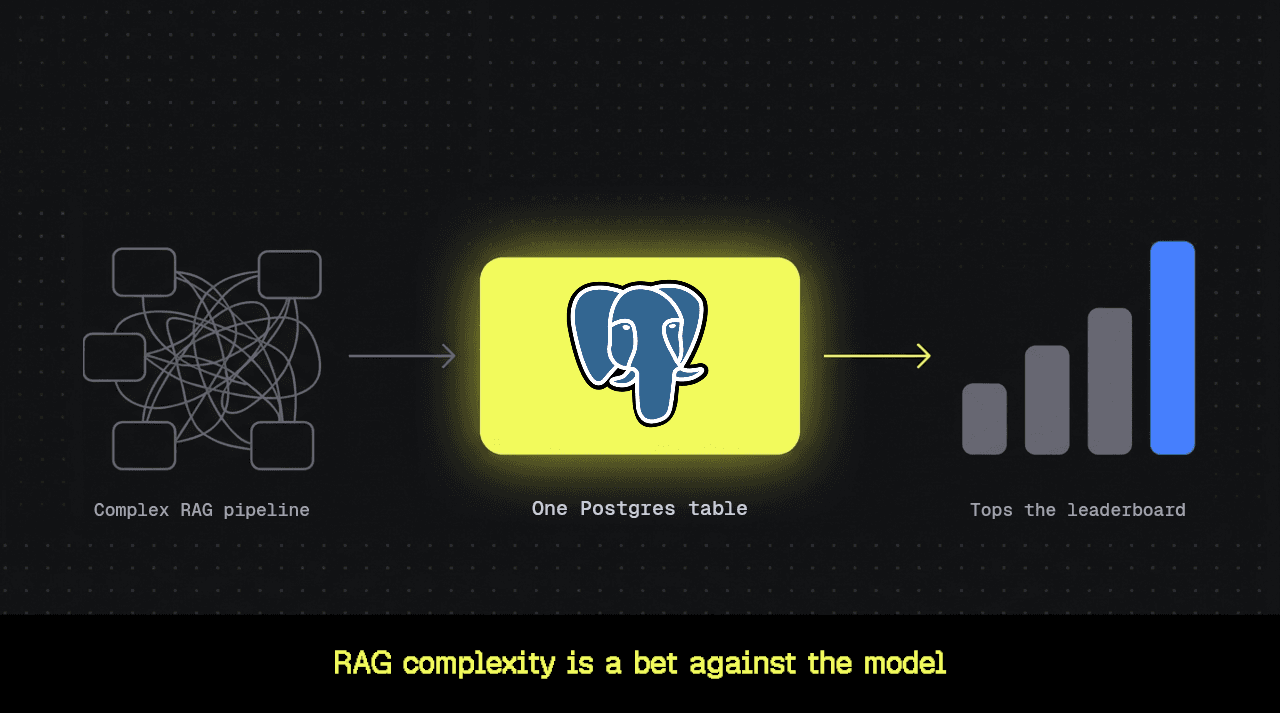
RAG Complexity Is a Bet Against the Model

One Postgres table with two indexes beat every published RAG pipeline on MuSiQue. Every architectural addition is a bet the model stays weak.

By Matvey Arye

September 30th, 2026

Agent Memory Is a Search Problem, Not a Storage Problem

AI

AI agents

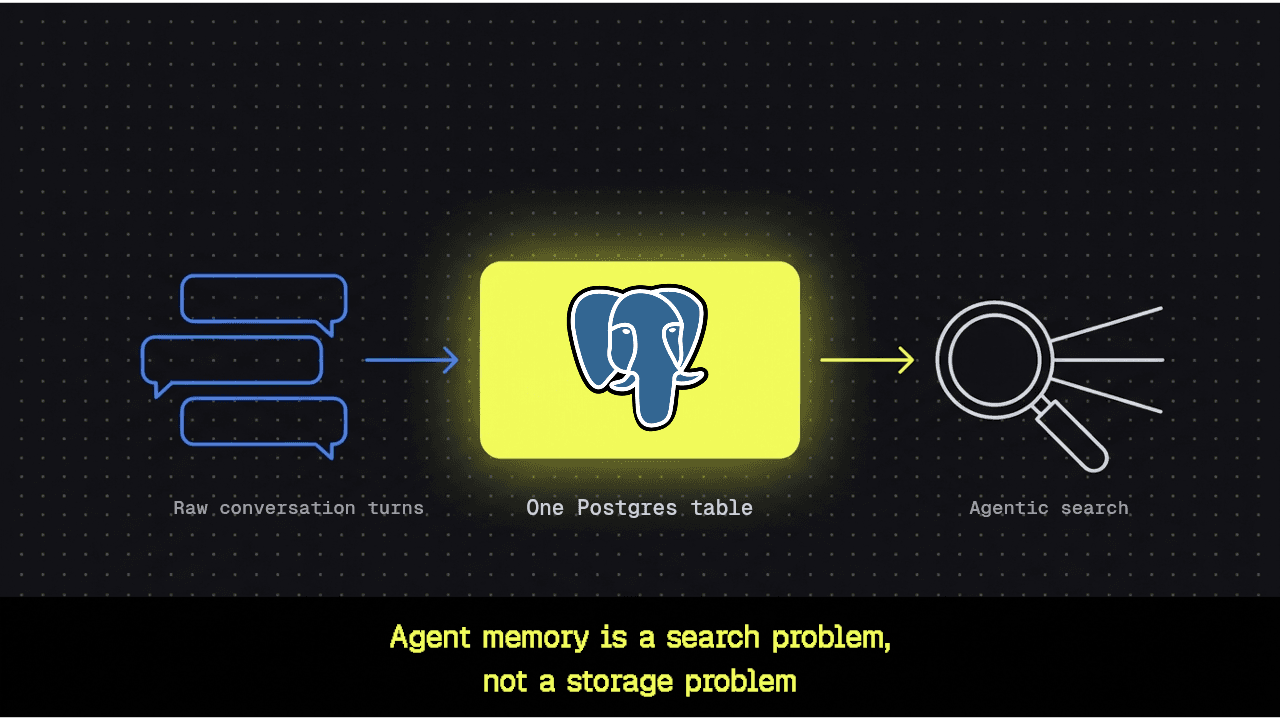
Agent Memory Is a Search Problem, Not a Storage Problem

No fact extraction, no graphs, no memory manager. One Postgres table and three search tools scored F1 0.665 on LoCoMo.

By Matvey Arye

September 29th, 2026
41 Experiments in 6 Days: What the Human Was Actually For

AI

AI agents

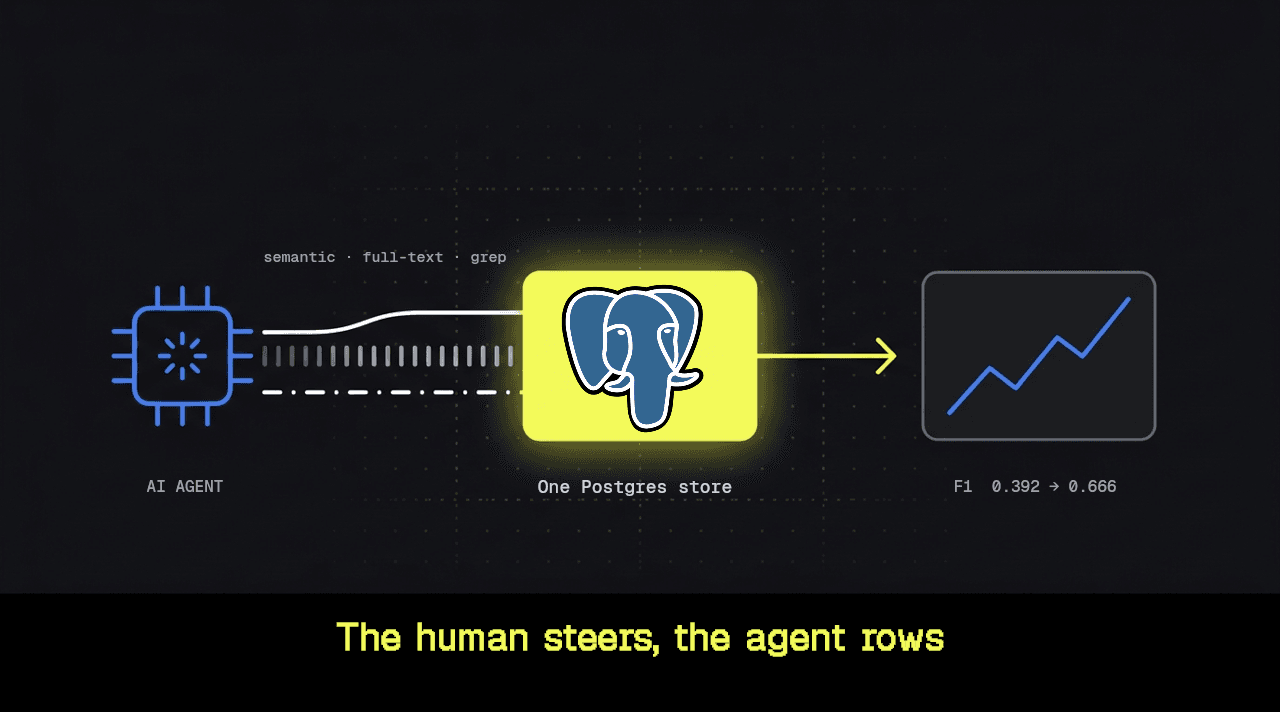
41 Experiments in 6 Days: What the Human Was Actually For

41 experiments in 6 days took LoCoMo memory from F1 0.392 to 0.666. Claude wrote the code; the human caught the metrics that were lying.

By Matvey Arye

September 28th, 2026

Stay updated with new
posts and releases.

Receive the latest technical articles and release notes in your inbox.